Showing posts with label Poetry. Show all posts

Monday, May 25, 2015

"In Flanders Fields," the Story of Major John McCrae

This post was originally published here on May 27, 2007.  I first read the poem in my sophomore year of high school, and it's impact has stayed with me for more than half a century.  I am reposting it for Memorial Day 2015.

******

I have always loved the poem "In Flanders Fields," written by Canadian officer John McCrae in World War I. (Flanders is a section of Belgium).  I found his story at the website of Arlington National Cemetery. Here it is.
---------------------------------

McCrae's "In Flanders Fields" remains to this day one of the most memorable war poems ever written. It is a lasting legacy of the terrible battle in the Ypres salient in the spring of 1915. Here is the story of the making of that poem:

Although he had been a doctor for years and had served in the South African War, it was impossible to get used to the suffering, the screams, and the blood here, and Major John McCrae had seen and heard enough in his dressing station to last him a lifetime.

As a surgeon attached to the 1st Field Artillery Brigade, Major McCrae, who had joined the McGill faculty in 1900 after graduating from the University of Toronto, had spent seventeen days treating injured men -- Canadians, British, Indians, French, and Germans -- in the Ypres salient.

It had been an ordeal that he had hardly thought possible. McCrae later wrote of it:
"I wish I could embody on paper some of the varied sensations of that seventeen days... Seventeen days of Hades! At the end of the first day if anyone had told us we had to spend seventeen days there, we would have folded our hands and said it could not have been done."

One death particularly affected McCrae. A young friend and former student, Lieut. Alexis Helmer of Ottawa, had been killed by a shell burst on 2 May 1915. Lieutenant Helmer was buried later that day in the little cemetery outside McCrae's dressing station, and McCrae had performed the funeral ceremony in the absence of the chaplain.

The next day, sitting on the back of an ambulance parked near the dressing station beside the Canal de l'Yser, just a few hundred yards north of Ypres, McCrae vented his anguish by composing a poem. The major was no stranger to writing, having authored several medical texts besides dabbling in poetry.

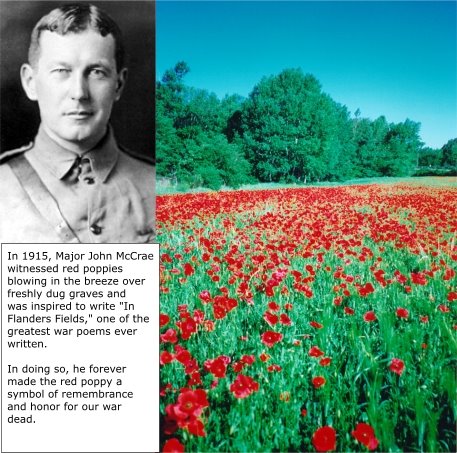
In the nearby cemetery, McCrae could see the wild poppies that sprang up in the ditches in that part of Europe, and he spent twenty minutes of precious rest time scribbling fifteen lines of verse in a notebook.

A young soldier watched him write it. Cyril Allinson, a twenty-two year old sergeant-major, was delivering mail that day when he spotted McCrae. The major looked up as Allinson approached, then went on writing while the sergeant-major stood there quietly. "His face was very tired but calm as we wrote," Allinson recalled. "He looked around from time to time, his eyes straying to Helmer's grave."

When McCrae finished five minutes later, he took his mail from Allinson and, without saying a word, handed his pad to the young NCO. Allinson was moved by what he read:
"The poem was exactly an exact description of the scene in front of us both. He used the word blow in that line because the poppies actually were being blown that morning by a gentle east wind. It never occurred to me at that time that it would ever be published. It seemed to me just an exact description of the scene."
In fact, it was very nearly not published. Dissatisfied with it, McCrae tossed the poem away, but a fellow officer retrieved it and sent it to newspapers in England. The Spectator, in London, rejected it, but Punch published it on 8 December 1915.
-----------------------------------------------
Stogie again. Red poppies are flowers whose seeds can remain dormant for years, and are activated into germination when the earth is broken or turned. When the soldiers in Belgium began burying their dead, there was a lot of freshly turned earth. In a few days the fresh graves were ablaze with the red poppies, as if God Himself had decorated the graves.

Because of this, the red poppy became a symbol of Memorial Day and for many years was worn by many to remember the war dead. This is an old tradition we should work to revive.

Here is McCrae's famous and beautiful poem, written 100 years ago this month, on May 3, 1915:

IN FLANDERS FIELDS
Maj. John McCrae (1872-1918)
.....
In Flanders fields the poppies blow
Between the crosses, row on row
That mark our place; and in the sky
The larks, still bravely singing, fly
Scarce heard amid the guns below.
.....
We are the Dead. Short days ago
We lived, felt dawn, saw sunset glow,
Loved and were loved, and now we lie
In Flanders fields.
......
Take up our quarrel with the foe:
To you from failing hands we throw
The torch; be yours to hold it high.
If ye break faith with us who die
We shall not sleep, though poppies grow
In Flanders fields.

Friday, December 23, 2011

A Democrat Poem From 1949, Still So Relevant For Today

A couple of weeks ago, Always on Watch posted the scan from a newspaper in 1949. The paper carried a poem, "Ode to the Welfare State." I loved the poem, and transcribed into a Word document; but I didn't want to steal AOW's thunder so I didn't run it right away. The graphic of the newspaper is below, followed by my transcription, to enable other bloggers easier ways to run it, copy it or email it.


ODE TO THE WELFARE STATE
Rep Clarence J. Brown, R-Ohio, 1949
A poem put into the Congressional Record

Democratic Dialogue

Father must I go to work?
No my lucky son,
We’re living now on Easy Street
On dough from Washington.

We’ve left it up to Uncle Sam
So don’t get exercised.
Nobody has to give a damn –
We’ve all been subsidized.

But if Sam treats us all so well
And feeds us milk and honey,
Please daddy, tell me what the hell
He’s going to use for money.

Don’t worry Bub, there’s not a hitch
In this here noble plan –
 He simply soaks the filthy rich
And helps the common man.

But father, won’t there come a time
When they run out of cash
And we have left them not a dime
When things will go to smash?

My faith in you is shrinking, son,
You nosy little brat;
You do too much thinking, son,
To be a Democrat.

Thursday, September 30, 2010

General McCain's Speech to the Troops on the Eve of Battle

Stacy McCain has pointed to the example of the great General George S. Patton on the mindset needed to win the coming battle for America.  He has penned an inspiring post, Lessons of Failure and Hope of Success:  Reflections on the Eve of Battle.  Stacy writes:
Victory is the choice we make when we decide that no defeat can make us stop fighting. If you are defeated today, return to the battlefield tomorrow even more determined to prevail. And no matter how often you lose, you can never be defeated so long as you continue the fight.

We are now on the eve of a political battle that could determine whether America is to achieve its destiny or be doomed to deserved oblivion, having failed to live up to that ancient vision of the City on a Hill.
Indeed, after our terrible electoral defeat in November 2008, I wrote a post titled:  "Tomorrow we begin again."  It's only content was a Photoshop graphic of the Statue of Liberty lying in ruins on a lonely beach, similar to a scene in "Planet of the Apes."  On that terrible day, we could do naught but view the ruin and the wreckage and feel the depths of our defeat.  But even then we knew we weren't through.  We would return again to the fight.  As Churchill once advised, "Never give up.  Never, never, never give up."

Occasional defeats are the price of success.  Another great American, Teddy Roosevelt, made a speech at the Sorbonne University in Paris, France on April 23, 1910.  The most memorable quote from that speech will forever be an inspiration to those who strive for something better.  He said:
It is not the critic who counts; not the man who points out how the strong man stumbles, or where the doer of deeds could have done them better. The credit belongs to the man who is actually in the arena, whose face is marred by dust and sweat and blood; who strives valiantly; who errs, who comes short again and again, because there is no effort without error and shortcoming; but who does actually strive to do the deeds; who knows great enthusiasms, the great devotions; who spends himself in a worthy cause; who at the best knows in the end the triumph of high achievement, and who at the worst, if he fails, at least fails while daring greatly, so that his place shall never be with those cold and timid souls who neither know victory nor defeat.
Stacy McCain can count himself among the "men in the arena," and never be one of the "cold and timid souls," and his efforts on our behalf are an inspiration in themselves.

Wednesday, May 14, 2008

It Was My Last Cigar

I'm all out of cigars. Whenever that happens I think of a poem I learned in sophomore English in high school. It was called "My Last Cigar." I haven't seen that poem in 40+ years, but sure enough, I found it on the internet.

Here it is.

My Last Cigar

‘Twas off the blue Canary Isles, a glorious summer day,
I sat upon the quarter deck and wiff’d my cares away
And as the volumed smoke arose, like incense in the air,
I breath’d a sigh to think in sooth, it was my last cigar

I lean’d against the quarter rail, and look’d down in the sea,
E’en there the purple wreath of smoke was curling gracefully;
Oh, what had I at such a time to do with wasting care?
Alas the trembling tear proclaim’d it was my last cigar.

I watch’d the ashes, as it came fast drawing t’ward the end,
I watch’d it as a friend would watch beside a dying friend;
But still the flame crept slowly on, it vanish’d into air,
I threw it from me – spare the tale – it was my last cigar.

I’ve seen the land of all I love fade in the distance dim,
I’ve watch’d above the blighted heart where once proud hope hath been;
But I’ve never known a sorrow that could with that compare,
When off the blue Canary Isles I smoked my last cigar.

****
This poem was composed by a naval officer on duty off the coast of Africa before the Civil War, when the United States kept a patrol there to guard against the slave trade.