Showing posts with label Patriotism. Show all posts

Monday, May 25, 2015

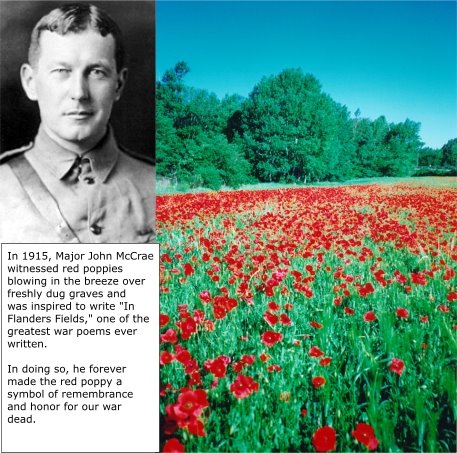
"In Flanders Fields," the Story of Major John McCrae

This post was originally published here on May 27, 2007.  I first read the poem in my sophomore year of high school, and it's impact has stayed with me for more than half a century.  I am reposting it for Memorial Day 2015.

******

I have always loved the poem "In Flanders Fields," written by Canadian officer John McCrae in World War I. (Flanders is a section of Belgium).  I found his story at the website of Arlington National Cemetery. Here it is.
---------------------------------

McCrae's "In Flanders Fields" remains to this day one of the most memorable war poems ever written. It is a lasting legacy of the terrible battle in the Ypres salient in the spring of 1915. Here is the story of the making of that poem:

Although he had been a doctor for years and had served in the South African War, it was impossible to get used to the suffering, the screams, and the blood here, and Major John McCrae had seen and heard enough in his dressing station to last him a lifetime.

As a surgeon attached to the 1st Field Artillery Brigade, Major McCrae, who had joined the McGill faculty in 1900 after graduating from the University of Toronto, had spent seventeen days treating injured men -- Canadians, British, Indians, French, and Germans -- in the Ypres salient.

It had been an ordeal that he had hardly thought possible. McCrae later wrote of it:
"I wish I could embody on paper some of the varied sensations of that seventeen days... Seventeen days of Hades! At the end of the first day if anyone had told us we had to spend seventeen days there, we would have folded our hands and said it could not have been done."

One death particularly affected McCrae. A young friend and former student, Lieut. Alexis Helmer of Ottawa, had been killed by a shell burst on 2 May 1915. Lieutenant Helmer was buried later that day in the little cemetery outside McCrae's dressing station, and McCrae had performed the funeral ceremony in the absence of the chaplain.

The next day, sitting on the back of an ambulance parked near the dressing station beside the Canal de l'Yser, just a few hundred yards north of Ypres, McCrae vented his anguish by composing a poem. The major was no stranger to writing, having authored several medical texts besides dabbling in poetry.

In the nearby cemetery, McCrae could see the wild poppies that sprang up in the ditches in that part of Europe, and he spent twenty minutes of precious rest time scribbling fifteen lines of verse in a notebook.

A young soldier watched him write it. Cyril Allinson, a twenty-two year old sergeant-major, was delivering mail that day when he spotted McCrae. The major looked up as Allinson approached, then went on writing while the sergeant-major stood there quietly. "His face was very tired but calm as we wrote," Allinson recalled. "He looked around from time to time, his eyes straying to Helmer's grave."

When McCrae finished five minutes later, he took his mail from Allinson and, without saying a word, handed his pad to the young NCO. Allinson was moved by what he read:
"The poem was exactly an exact description of the scene in front of us both. He used the word blow in that line because the poppies actually were being blown that morning by a gentle east wind. It never occurred to me at that time that it would ever be published. It seemed to me just an exact description of the scene."
In fact, it was very nearly not published. Dissatisfied with it, McCrae tossed the poem away, but a fellow officer retrieved it and sent it to newspapers in England. The Spectator, in London, rejected it, but Punch published it on 8 December 1915.
-----------------------------------------------
Stogie again. Red poppies are flowers whose seeds can remain dormant for years, and are activated into germination when the earth is broken or turned. When the soldiers in Belgium began burying their dead, there was a lot of freshly turned earth. In a few days the fresh graves were ablaze with the red poppies, as if God Himself had decorated the graves.

Because of this, the red poppy became a symbol of Memorial Day and for many years was worn by many to remember the war dead. This is an old tradition we should work to revive.

Here is McCrae's famous and beautiful poem, written 100 years ago this month, on May 3, 1915:

IN FLANDERS FIELDS
Maj. John McCrae (1872-1918)
.....
In Flanders fields the poppies blow
Between the crosses, row on row
That mark our place; and in the sky
The larks, still bravely singing, fly
Scarce heard amid the guns below.
.....
We are the Dead. Short days ago
We lived, felt dawn, saw sunset glow,
Loved and were loved, and now we lie
In Flanders fields.
......
Take up our quarrel with the foe:
To you from failing hands we throw
The torch; be yours to hold it high.
If ye break faith with us who die
We shall not sleep, though poppies grow
In Flanders fields.

Saturday, January 24, 2015

American Sniper: Why Do Leftists Hate It?

The movie "American Sniper" is a true story, based on the life of Chris Kyle.  Here's how it is described:
U.S. Navy SEAL Chris Kyle (Bradley Cooper) takes his sole mission -- protect his comrades -- to heart and becomes one of the most lethal snipers in American history. His pinpoint accuracy not only saves countless lives but also makes him a prime target of insurgents. Despite grave danger and his struggle to be a good husband and father to his family back in the States, Kyle serves four tours of duty in Iraq. However, when he finally returns home, he finds that he cannot leave the war behind.
The movie is smashing attendance records and appears to be the most popular film in a decade.  People who saw it say it is very moving.  It apparently also reawakens American patriotism.

Of course, "progressives" (Democrats, leftists and other crawly things) hate the film.  Michael Moore, leftist film maker and professional America-hater, denounced snipers as "cowards."

Why do "progressives" hate the film?  Simple.  "Progressives" hate the military, hate patriotism, hate white people, hate war against evil people with whom those progressives identify.  In fact, any time there is a struggle between good and evil in this world, the "progressives" will support and defend the latter with their dying breath.

Friday, June 06, 2014

D-Day Plus Seventy Years: My Uncle's Souvenirs of the Invasion of Normandy 1944

My Uncle Theo, a Texan, took part in the D-Day Invasion of Normandy in June of 1944.  He was a medic with the 2nd Armored Division and didn't land on Normandy Beach until June 7 -- D-Day + One.  When he died in 1957, he left us a suitcase filled with war mementos, collected from the invasion of Sicily (Italy) and also the Normandy invasion (France).  There were Nazi wallets, Italian uniform buttons, German, Italian and French cash and coins, German medals, a German first aid kit, German eating utensils, some unfired bullets, Nazi patches, and even a black Nazi helmet.  I still have most of these mementos, carefully preserved.

As a child going through the suit case, handling the artifacts, I could sense momentous events, Germans and Americans, horror and death. The Nazi wallets were stuffed with personal pictures of handsome young German soldiers posing with friends, family and sweethearts.  This impressed on me the reality of war.  These dead Germans were human beings, and I could feel a certain empathy for them while still hating their cause.  But if somebody had to die, I thought, better them than us.  We didn't start this war.

Uncle Theo? (Sitting)
I noticed a sour smell in the suitcase that seemed to emanate from an orange colored plastic bottle.  It had German writing on the side, so I didn't know what it was for.  Years later, a friend who spoke German told me the bottle contained a salve for rubbing on the skin after a chemical or gas attack.  Now, all these years later, I still associate that sour chemical smell with D-Day.  I still have that orange bottle, but the smell is very faint now.  My uncle's suitcase, which had absorbed much of the smell, crumbled into dust years ago.  I now store his Normandy items in a large, plastic, sealed storage box.


Looking at many pictures of D-Day, however, I get an impression that it was rainy and wet.  It was a massive logistics operation, moving men, weapons, supplies and machines onto Normandy Beach.  LST's, a small ship with doors that opened in the bow, pushed their noses up close to the beach.  A special bridge built by British engineers provided the runway from the LST bows to the beach.  The LST's opened their large doors and expelled tanks, trucks, jeeps, artillery and long lines of troops.  Funny to think that 70 years have passed since that great undertaking -- a lifetime ago.

LSTs Unloading Men, Weapons and Machines
Normandy Beach,  June 1944
(Click to see full size)
Life Magazine printed photographs of the Normandy invasion, and there is a photo of a balding, husky soldier sitting near the water's edge, next to a line of dead American soldiers, most of who drowned coming ashore.   They wore their army life jackets (actually, a doughnut shaped, inflatable tube) too low on their bodies, and the life jackets flipped them over, pointing their heads down into the water, drowning them.  The Army life jackets were poorly designed -- Navy jackets didn't do this.

My father wrote to my uncle, who was at that time "somewhere in France," sending him a clipping of the photo, and asking if it were him.  I still have his letter in response, a letter headed "In France" and dated August 17, 1944.  He wrote "About the clipping you sent [the answer] is yes, but I probably could give no details now.  You see, this division has been under rigid censorship for two years, being an arm'd [armored] division."  However, Unc is facing away from the camera, so we will never be able to prove it (but dang, it sure looks like him to me).  That's the photo above.

As the allied troops moved off the beaches and into the French interior, my uncle went with them, winning both a Bronze Star and a Silver Star for tending the wounded under heavy small arms and artillery fire, near Carentan, France.  He also won his second Purple Heart prior to the Battle of the Bulge (the first was in Sicily), when he was wounded and sent back to England to recover.

The Coast of Normandy as It Looks Today:

The American Cemetery is to the right, the last resting place for those who died on the beaches.

Some of the Artifacts Brought Back From Normandy
by My Uncle Theo, Pvt, 2nd Armored Division
Photo:  On the left is a photo I took of some of Unc's Normandy artifacts.  There's a picture of someone's sweetheart, a German First Aid kit, two wallets, a gray leather cartridge box that was affixed to a soldier's belt, a spoon/fork combination in a gray leather holder that also strapped onto a soldier's belt, that orange bottle mentioned earlier, a case that held the orange bottle, a real Nazi helmet in near-pristine condition, some wallets, a patch, some medals, a German soldier's belt bucklet, some bullets, and one more wallet.

I will make a second post of some of the pictures that my uncle found in wallets of fallen Nazi soldiers during the Normandy invasion.  These pictures, except for Alfred Schmid, have not been published anywhere before.

See post below this one for those pictures.


Thursday, June 05, 2014

Tomorrow's Post Will Be Interesting! Includes Photos Taken From Fallen German Soldiers (by My Uncle at Normandy)

Since it is the 70th anniversary of D-Day tomorrow, I have put some effort into my posts for that day.  I tell some personal tales of my Uncle Theo who went ashore on Normandy Beach on D-Day + 1 (and appeared in a Life photo on the beach).

Unc helped himself to the wallets of dead German soldiers, plucking them from their pockets and bringing them home as souvenirs.   These wallets contain the personal and family pictures of the German soldiers, some of which are quite poignant.  Adolf Hitler was not only the biggest SOB in modern history, he was the biggest SOB to the German people too -- sacrificing millions of their sons in an evil and ultimately, fruitless war.

The posts will publish automatically at 11:59 PM tonight and 12:00 AM tomorrow.

Tune in!

Sunday, May 25, 2014

Memorial Day: Did They Die In Vain?


I am not in much of a patriotic spirit this Memorial Day.  Considering the recent damage done to our freedoms, I find myself wondering about all those men and women who died for our country.  Did they die in vain?

There is today a determined political force intent on "transforming America," changing it into something never intended by its founders.  The Second Amendment is under constant attack, and lately the First is also in danger.  Our economy is in shreds, our military greatly weakened.  No external enemy could destroy us, but we are being undermined from within.

If our great nation is dying, it is because of self-inflicted wounds.  It's hard to be optimistic.  Can we the people save the great inheritance of freedom once bequeathed to us, and paid for in so many lives of our military?  I have not given up hope, but the hour is late.

Sunday, February 23, 2014

Song For Sunday: "The Last Farewell" by Roger Whittaker

Here is one of my favorite songs. It was meaningful to me when I was separated from my fiancee on a work assignment in Phoenix, back in 1975, when the song first appeared. Not only is the song romantic, it reminds us of a time when "Old England" was a courageous nation of British patriots who put love of country and duty above their own lives and personal safety. That was the country we Americans were so proud to be descended from. Now today both of our nations are in decline, due to population replacement and the corrosive acid of socialism.


Monday, November 11, 2013

Thanks Veterans!

Today is Veteran's Day.  Thanks to all our vets, either serving or retired from the military.  Although it's true that "freedom isn't free," I have grave doubts about the utility of our efforts in Iraq and Afghanistan.  I do not believe that any Islamic nation is compatible with representative democracy.  In short, our efforts to transform barbarians into democrats is a fool's errand.

The lives of our military personnel should not be expended on dubious missions, nor used to "nation build."  I resent the death of every soldier, sailor, airman or marine who is shipped home in a box.

Thursday, June 06, 2013

D-Day + 69 Years

This week, Rush Limbaugh visited Normandy, France and toured the scenes of D-Day, the allied invasion of Nazi-held France, 69 years ago today.

No matter how much time passes, that day in history will always be foremost in my mind, when I think of valor and courage and victory over evil.  I hope to visit Normandy, and Omaha Beach, before I die.  I would like to pay my respects to the American dead, thousands of whom are buried there under white marble crosses and green grass.

Rush describes his impressions and emotions of the visit here.

On the 40th anniversary of D-Day, President Ronald Reagan gave one of his most inspiring speeches at the scene, "The Boys of Pointe Du Hoc."  Here it is.


Wednesday, June 06, 2012

D-DAY REMEMBERED: 68 YEARS AGO TODAY


I created this image from an actual modern photograph of Omaha Beach, with overlaid figures of actual American soldiers who landed there 68 years ago today. D-Day was one of the bloodiest and costliest battles in American war history. We should never forget those who died there.

Sunday, May 27, 2012

Better Men Than I: Memorial Day 2012


The men above, and many thousands like them, are better men than I. I never served my country, never went in harm's way. I regret that. For most of my life my eyesight was horrible, up until I had lasic surgery late in life.  My childhood dream of serving in the US Navy was never to be realized.

The military cemetery featured above is one at Cambridge, England, where 3,812 American casualties of World War II are buried.  Superimposed are the images of Americans (and one Canadian) who died in war.  They are, top, left to right:

Alan Seeger was a Harvard Graduate, Class of 1910, who wrote stunning poetry, including the famous war poem "I Have a Rendezvous With Death."  He joined the French Foreign Legion to fight in World War I. He was killed on July 4, 1916 by German machine gun fire as his French Foreign Legion unit charged German positions near Belloy-En-Santerre, France.

General George S. Patton was an aggressive American general in World War II who won many victories for the allies.  My Uncle served under his command, as a private and medic in the 2nd Armored Division.  Patton was killed in December 1945, just after the war had ended, in a jeep accident.

Doris Miller, a Navy sailor and cook, was a crew member of the USS West Virginia at Pearl Harbor when the Japanese attacked on December 7, 1941.  As Japanese planes dove all around the ship, dropping torpedoes and bombs, Miller found a loaded machine gun that had been dropped on the deck.  He picked it up and began firing at the Japanese planes, possibly downing one, until he ran out of ammunition.  Cited for his bravery in the heat of battle, Miller was awarded the Navy Cross.  He was killed in action later in the war.

John McCrae, a Canadian officer in Europe during World War I, was a surgeon who treated the wounded in the Flanders section of Belgium.  Outside of his dressing station was a makeshift cemetery where red poppies naturally sprouted in the freshly overturned soil of the graves.  McCrae was inspired to write possibly the most famous war poem of all time, "In Flanders Fields."  McCrae later died of pneumonia before the war's end.

Pat Tillman, a professional football player who abandoned a lucrative sports contract to serve his country, died in Afghanistan by "friendly fire."  Pat's father was my youngest son's coach in Pony League baseball in Almaden Valley in 1993-94, and I saw Pat once at one of the practices.

William E Shipp, a lieutenant in the US Army, served with the Tenth Cavalry during the Spanish-American War.  He was killed in the charge up San Juan Hill on July 1, 1898.

Nathan Hale, Captain in the Continental Army, served in the Revolutionary War for American independence.  He was hanged by the British as a spy on September 22, 1776.  Reportedly his last words were "I regret that I have but one life to lose for my country."

John  Morreale, Staff Sergeant in the US Airforce in WW II, was a radio operator with a 10-man crew flying a Boeing B-17 Flying Fortress.  He was one of the men who flew combat missions from bases in England to Germany, bombing Nazi munitions factories, railroad yards, and submarine pens in preparation for the June 6 invasion.  His bomber the "Fancy Nancy III" was shot down over Brunswick, Germany on January 30, 1944.  Five members of the crew were able to bail out before the plane crashed.  Unfortunately, Sgt Morreale was not one of them.

*******

These are but a very small few of the American and allied heroes who gave their lives in war.  Each of the thousands of white crosses in military cemeteries around the world represents one precious human life.

They gave all of their tomorrows for all of our todays.  Let us never forget what their lives have bequeathed.


Friday, November 18, 2011

Medal of Honor Recipients in Arlington National Cemetery

I wandered onto a page listing all of the Medal of Honor recipients who are buried in Arlington Cemetery.  I selected several names at random just to read about the man behind the name.  The result was several inspiring stories of valor and bravery, of soldiers, sailors, marines and airmen.  One was a captain in the horse cavalry who fought Indians in Arizona.  Another was a marine who served in China during the Boxer Rebellion in 1900.  A soldier earned his medal in 1918, in World War I in France, and a sailor saved lives in Korea in 1951.  Of course, there were some stories from World War II as well.

There was only one name in the Z section, that of Lt. Colonel James Zeamer Jr., of the United States Army Air Corps (the service that predated the Air Force).  Zeamer won the Medal of Honor fighting off Japanese fighters from a bomber near New Guinea in 1943.  One of his crewmen, one Joseph R. Sarnoski, also won the Medal of Honor in the same plane in the same fight.  Sarnoski shot down several Japanese planes, but was mortally wounded in the fight.  Knocked down by an explosive shell, he crawled back to his machine gun and continued firing until death overtook him.  He died at his station.

Sarnoski was awarded the Medal of Honor posthumously, was buried in New Guinea, his remains later relocated to the National Memorial Cemetery of the Pacific, in Hawaii.  Read all about this brave American here.

Lt. Colonel Zeamer survived World War II and died in March 2007 at the age of 88, his interment being in Arlington Cemetery.

If you want inspiration by great Americans, do visit this site and read several obituaries at random.  You will meet great men from other times and be inspired.

Saturday, November 12, 2011

Eagle on Gravestone in Military Cemetery (Photo)

I found this on the web.  I don't know if the photo is real or if the eagle was added via Photoshop, but it is an inspiring image nonetheless.

Update: the photo is real. The photo was taken by Frank Glick in Fort Snelling National Cemetery in Minneapolis, Minnesota. Glick's hobby is photography and he was visiting the cemetery when he spotted the eagle atop a veteran's gravestone. Another man who saw the photo did some research to learn the identity of the veteran on whose gravestone the eagle alighted. He learned it was Sgt. Maurice Ruch, a veteran of World War II. Ruch's widow as well as his best friend were greatly inspired by the photo when it was finally shown to them.

Read the whole inspiring story here.


We Were Soldiers Once, and Young (Patriotic Image)

Our aging veterans cast a long shadow.

Sunday, May 29, 2011

Memorial Day 2011

Confederate Memorial at Arlington National Cemetery
Sculpted by Moses J. Ezekiel
Confederate Memorial, Arlington Cemetery

Dedicated 1914; Sculpture by Sir Moses Ezekiel, former Sergeant of Cadets, Virginia Military Institute, who is himself buried at the base of this monument.

Inscription:
NOT FOR FAME OR REWARD, NOT FOR PLACE OR FOR RANK, NOT LURED BY AMBITION OR GOADED BY NECESSITY, BUT IN SIMPLE OBEDIENCE TO DUTY AS THEY UNDERSTOOD IT, THESE MEN SUFFERED ALL, SACRIFICED ALL, DARED ALL, AND DIED 

See also jameswebb.com, Speech at the Confederate Memorial, 1990.

Moses J. Ezekiel was one of the VMI cadets who were called into action to plug a hole in the Confederate center at the Battle of New Market, and to repulse a Union Army advance.  Though young (17 to 21 years of age) and untested in battle, the VMI cadets prevailed, charging the Union cannon and sending the Yankees into retreat.  Ten of the cadets were killed outright or later died of wounds from the battle; fifty-seven were wounded.  Although Ezekiel later became a world-renowned sculptor, he chose to be identified on his tombstone simply as:
Sgt. Moses J. Ezekiel

Moses J. Ezekiel
Sergeant of Company C
Battalion of Cadets
of the
Virginia Military Institute

Ezekiel once wrote: "The VMI, where every stone and blade of grass is dear to me, and the name of the cadet of the VMI, the proudest and most honored title I can ever possess."

A detailed description of his life and works can be found here.  

Virginia never had a finer son. May he rest in peace.

****

For more of my views of Memorial Day, see my 2006 (updated to 2007) post, "In Flanders Fields." That story and the poem it created is unsurpassed in our remembrance of our war dead.

A list of several prior year posts on Memorial Days past can be found at this link.

Friday, July 04, 2008

"America the Beautiful" the Story of the Song

The great American hymn "America the Beautiful" has an interesting history. Here are some facts about it from Wikipedia.
The words are by Katharine Lee Bates, an English professor at Wellesley College. In 1893, Bates had taken a train trip to Colorado Springs, Colorado, to teach a short summer school session at Colorado College, and several of the sights on her trip found their way into her poem: The World's Columbian Exposition in Chicago, the "White City" with its promise of the future contained within its alabaster buildings.

The wheat fields of Kansas, through which her train was riding on July 4.

The majestic view of the Great Plains from atop Pikes Peak.

On that mountain, the words of the poem started to come to her, and she wrote them down upon returning to her hotel room at the original Antlers Hotel. The poem was initially published two years later in The Congregationalist, to commemorate the Fourth of July. It quickly caught the public's fancy. Amended versions were published in 1904 and 1913.

Several existing pieces of music were adapted to the poem. The Hymn tune composed in 1882 by Samuel A. Ward, was generally considered the best music as early as 1910 and is still the popular tune today. Ward had been similarly inspired. The tune came to him while he was on a ferryboat trip from Coney Island back to his home in New York City after a leisurely summer day, and he immediately wrote it down. Ward died in 1903, not knowing the national stature his music would attain. Miss Bates was more fortunate, as the song's popularity was well-established by her death in 1929.
Stogie's comment: I once saw the story of this great American hymn on the History Channel. What was so amazing was that Samuel Ward's tune was adapted to the poem to create the song, and fit the words perfectly! Yet Bates wrote her poem and Ward wrote his tune completely separate from one another.

Here is one of the best renditions of that song ever sung, by Ray Charles, followed by the words.


AMERICA THE BEAUTIFUL

O beautiful for spacious skies,
For amber waves of grain,
For purple mountain majesties
Above the fruited plain!
America! America!
God shed his grace on thee
And crown thy good with brotherhood
From sea to shining sea!

O beautiful for pilgrim feet
Whose stern impassioned stress
A thoroughfare of freedom beat
Across the wilderness!
America! America!
God mend thine every flaw,
Confirm thy soul in self-control,
Thy liberty in law!

O beautiful for heroes proved
In liberating strife.
Who more than self their country loved
And mercy more than life!
America! America!
May God thy gold refine
Till all success be nobleness
And every gain divine!

O beautiful for patriot dream
That sees beyond the years
Thine alabaster cities gleam
Undimmed by human tears!
America! America!
God shed his grace on thee
And crown thy good with brotherhood
From sea to shining sea!

O beautiful for halcyon skies,
For amber waves of grain,
For purple mountain majesties
Above the enameled plain!
America! America!
God shed his grace on thee
Till souls wax fair as earth and air
And music-hearted sea!

O beautiful for pilgrims feet,
Whose stem impassioned stress
A thoroughfare for freedom beat
Across the wilderness!
America! America!
God shed his grace on thee
Till paths be wrought through
wilds of thought
By pilgrim foot and knee!

O beautiful for glory-tale
Of liberating strife
When once and twice,
for man's avail
Men lavished precious life!
America! America!
God shed his grace on thee
Till selfish gain no longer stain
The banner of the free!

O beautiful for patriot dream
That sees beyond the years
Thine alabaster cities gleam
Undimmed by human tears!
America! America!
God shed his grace on thee
Till nobler men keep once again
Thy whiter jubilee!

Independence Day: Images of the 4th of July

Some of the best images of July 4th and some of the greatest praise for the USA come from an unexpected source: French blogs.

Of course, I have been seeking out the pro-America, pro-Israel, pro-liberty French resistance for some time, so such sources are not unexpected to me. Here are some of the images. The lady with the star-spangled hat is from Le Blog Drzz, as is the "God Bless America" image to the right.


The images below are from "America, Home of the Brave." The men who man that blog are already better Americans than many who were born here. God blesses America when He blesses her with friends like these.


A painting of Washington observing the first American flag. On the right, a graphic of that flag, with 13 stars.


And finally, the modern flag, gloriously unfurled to the breeze!


Friday, June 06, 2008

Remembering D-Day

Today marks the 63rd anniversary of D-Day, the massive allied invasion of Nazi-occupied France. On June 6, 1944 American, British and Canadian troops landed on the Normandy coast amid stiff Nazi resistance. The Americans landed on the worst beach, "Bloody Omaha." More than 130,000 allied troops landed on Normandy that first day. Many were killed before firing a shot. Able Company, the first company ashore, suffered severe casualties. Some landing craft were sunk and never made it to shore; one that did land had its entire content of soldiers machine gunned seconds after the ramp dropped. Everyone of them was killed.

Only two riflemen from Company A fought effectively that day. They joined a Ranger battallion and fought with them. In one day, American fatalities were greater than those suffered in four years in Iraq.

To fully comprehend the horror that day, read "First Wave at Omaha Beach" by S.L.A. Marshall.

Our friends at the French blog "Support American Soldiers" also has an extensive article on D-Day, complete with pictures and maps.

Give a thought today to the thousands of soldiers who died and those who survived. They were heroes in ways we cannot begin to understand.

My uncle went ashore on Omaha Beach on D-Day+1. He was a medic. Before the invasion, he (and all other soldiers) received a printed message from General Eisenhower. I have that message, along with other artifacts from my uncle's participation. A scanned copy of it is below. Click on the image to see it full size.