Memorial Day, 2016. I am rather apathetic about Memorial Day this year. The Zeitgeist has determined that Confederate soldiers, sailors and marines are to be written out of American history and inclusion. Monuments and memorials to these veterans are being desecrated and eradicated in a fanatical frenzy all over the country. Placement of Confederate flags on Confederate graves is forbidden in national cemeteries. Perhaps at some point, Confederate tombstones will be bulldozed, lest Black Thugs Matter be offended by men 150 years dead.
American soldiers have not always fought for freedom, though we like to attach that flowery phrase to their mortal sacrifices. The American fighting man did indeed fight for freedom in the Revolutionary War and World War II, as well as Korea and Vietnam. In those wars they opposed an enemy dedicated to the destruction of self-determination and self-governance.
Of course, in Korea and Vietnam, our troops fought for the freedom of someone else, not Americans. Perhaps our involvement can be rationalized by the belief that, if Communist aggression were allowed to proceed unchecked, then our own freedom would be jeopardized in the near future. Was the death toll worth it? The answer is subjective. I am happy that Korea was spared from the collectivist tyranny, and I regret that the Democrat Party sold our Vietnamese allies down the river.
Other wars in our history are not as clear cut. Did we fight for freedom in the Civil War? Yes and no. The South fought for the right to govern itself; the North fought to prevent it.
Did we fight for freedom in the Spanish-American war? If so, it isn't obvious to me. Likewise in the Mexican war of the 1840s. Texas fought to secede from Mexico and govern itself, so as far as Texas is concerned, they were indeed fighting for freedom, i.e. Texas independence. Mostly, however, that war was merely a land grab. Mexico had lands that we wanted, and we took them by force.
Did we fight for freedom in World War I? No. We probably should never have gotten involved. It is said that we were fighting "to make the world safe for democracy." What balderdash. If anything, we fought to defend our allies in Britain and France against the Germans -- kinfolk supporting kinfolk in a time of crisis, even though there was no clear-cut case of good vs evil. World War I was a confused and chaotic mess without any clear goals for either side. To this day I cannot tell you what the two sides were fighting for. It remains a mystery.
Did we fight for freedom in Iraq and Afghanistan? The answer seems clear: no. I think we fought there to destroy the threat of attacks by Islamists against other Islamists and against ourselves. The theory was that by turning Iraq and Afghanistan into modern democracies, they would lose their aggressive tendencies, much as Germany and Japan did after their defeat in World War II. This was prefaced on the mistaken belief that all peoples, everywhere, secretly yearn for democracy and individual freedom. They do not so yearn in Muslim countries, or at least, the majority do not. They want to be ruled by fanatical clerics and Sharia law. Attempting to turn these barbarian cultures into modern, pluralistic democracies was a fool's errand from the start. Most of the American lives lost there were wasted.
Not all American soldiers and sailors and marines died "for freedom." Although we should keep our military strong and ready, it should not be used to enter ambiguous wars where there is no clear threat to our own freedoms. The lives of our sons and daughters are too precious to waste.
Showing posts with label Memorial Day. Show all posts
Sunday, May 29, 2016
Monday, May 25, 2015
"In Flanders Fields," the Story of Major John McCrae
This post was originally published here on May 27, 2007. I first read the poem in my sophomore year of high school, and it's impact has stayed with me for more than half a century. I am reposting it for Memorial Day 2015.
******
I have always loved the poem "In Flanders Fields," written by Canadian officer John McCrae in World War I. (Flanders is a section of Belgium). I found his story at the website of Arlington National Cemetery. Here it is.
---------------------------------
McCrae's "In Flanders Fields" remains to this day one of the most memorable war poems ever written. It is a lasting legacy of the terrible battle in the Ypres salient in the spring of 1915. Here is the story of the making of that poem:
Although he had been a doctor for years and had served in the South African War, it was impossible to get used to the suffering, the screams, and the blood here, and Major John McCrae had seen and heard enough in his dressing station to last him a lifetime.
As a surgeon attached to the 1st Field Artillery Brigade, Major McCrae, who had joined the McGill faculty in 1900 after graduating from the University of Toronto, had spent seventeen days treating injured men -- Canadians, British, Indians, French, and Germans -- in the Ypres salient.
It had been an ordeal that he had hardly thought possible. McCrae later wrote of it:
"I wish I could embody on paper some of the varied sensations of that seventeen days... Seventeen days of Hades! At the end of the first day if anyone had told us we had to spend seventeen days there, we would have folded our hands and said it could not have been done."
One death particularly affected McCrae. A young friend and former student, Lieut. Alexis Helmer of Ottawa, had been killed by a shell burst on 2 May 1915. Lieutenant Helmer was buried later that day in the little cemetery outside McCrae's dressing station, and McCrae had performed the funeral ceremony in the absence of the chaplain.
The next day, sitting on the back of an ambulance parked near the dressing station beside the Canal de l'Yser, just a few hundred yards north of Ypres, McCrae vented his anguish by composing a poem. The major was no stranger to writing, having authored several medical texts besides dabbling in poetry.
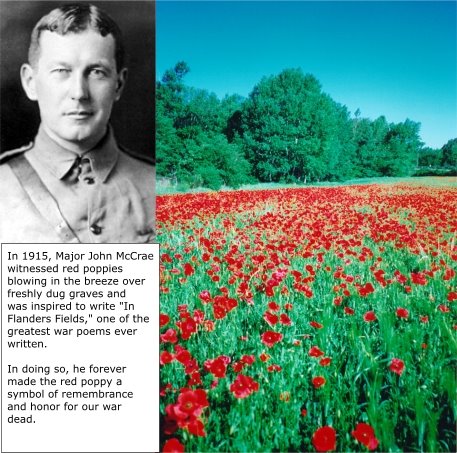
In the nearby cemetery, McCrae could see the wild poppies that sprang up in the ditches in that part of Europe, and he spent twenty minutes of precious rest time scribbling fifteen lines of verse in a notebook.
A young soldier watched him write it. Cyril Allinson, a twenty-two year old sergeant-major, was delivering mail that day when he spotted McCrae. The major looked up as Allinson approached, then went on writing while the sergeant-major stood there quietly. "His face was very tired but calm as we wrote," Allinson recalled. "He looked around from time to time, his eyes straying to Helmer's grave."
When McCrae finished five minutes later, he took his mail from Allinson and, without saying a word, handed his pad to the young NCO. Allinson was moved by what he read:
"The poem was exactly an exact description of the scene in front of us both. He used the word blow in that line because the poppies actually were being blown that morning by a gentle east wind. It never occurred to me at that time that it would ever be published. It seemed to me just an exact description of the scene."In fact, it was very nearly not published. Dissatisfied with it, McCrae tossed the poem away, but a fellow officer retrieved it and sent it to newspapers in England. The Spectator, in London, rejected it, but Punch published it on 8 December 1915.
-----------------------------------------------
Stogie again. Red poppies are flowers whose seeds can remain dormant for years, and are activated into germination when the earth is broken or turned. When the soldiers in Belgium began burying their dead, there was a lot of freshly turned earth. In a few days the fresh graves were ablaze with the red poppies, as if God Himself had decorated the graves.Because of this, the red poppy became a symbol of Memorial Day and for many years was worn by many to remember the war dead. This is an old tradition we should work to revive.
Here is McCrae's famous and beautiful poem, written 100 years ago this month, on May 3, 1915:
IN FLANDERS FIELDS
Maj. John McCrae (1872-1918)
.....
In Flanders fields the poppies blow
Between the crosses, row on row
That mark our place; and in the sky
The larks, still bravely singing, fly
Scarce heard amid the guns below.
.....
We are the Dead. Short days ago
We lived, felt dawn, saw sunset glow,
Loved and were loved, and now we lie
In Flanders fields.
......
Take up our quarrel with the foe:
To you from failing hands we throw
The torch; be yours to hold it high.
If ye break faith with us who die
We shall not sleep, though poppies grow
In Flanders fields.
Labels:
In Flanders Fields,
John McCrae,
Memorial Day,
Patriotism,
Poetry,
Remembrance,
War Dead
Memorial Day is Every Day for the Dutch Caretakers of American Graves
Here is a wonderful story of remembrance of the American war dead in Holland. Hat tip to Always on Watch.
Sunday, May 24, 2015
Memorial Day, 2015
1. Memorial Day, 2014: Did They Die In Vain? A reflection on how modern politicians have betrayed those who fought and died for our country.
2. Memorial Day, 2013: Freedom Isn't Free. A video.
3. Memorial Day, 2012: Better Men Than I. A commentary on several great fighting men who made the ultimate sacrifice in war.
4. Memorial Day, 2011: The Confederate Memorial in Arlington Cemetery. Jewish VMI Cadet Moses Ezekiel, a personal hero of mine.
5. Memorial Day, 2009: The American Cemetery in Normandy, France, containing the dead from the D-Day invasion of June 6, 1944.
6. Memorial Day 2008: Photos from friends, depicting those who died in war.
7. Memorial Day 2007: Thoughts on a local sailor who died in 1969.
8. Memorial Day 2006: The Tomb of the Unknown Soldier; poem, The Bivouac of the Dead.
9. Major John McCrae: The Story of "In Flanders Fields." This is probably the best post on the subject of Memorial Day.
10. Remembering Pearl Harbor and the lessons of history.
11. Memorial Service for the Crew of the U.S.S. Grunion (WWII Submarine). Video and song, the Navy Hymn.
12. Memorial Day Meditations: Freedom Isn't Free; Alan Seeger's Life and Poem "I Have a Rendezvous with Death." This probably ties No. 9 as the best post on the subject of Memorial Day. Alan Seeger was an American who served with the French Foreign Legion, fighting the Germans in World War I France. Seeger graduated from Harvard University in 1910 -- 105 years ago.
13. Song & video: Battle Hymn of the Republic
14. Story, Song & video: America the Beautiful
Labels:
American Patriots,
American history,
Memorial Day,
Remembrance,
War
Sunday, May 25, 2014
Memorial Day: Did They Die In Vain?
I am not in much of a patriotic spirit this Memorial Day. Considering the recent damage done to our freedoms, I find myself wondering about all those men and women who died for our country. Did they die in vain?
There is today a determined political force intent on "transforming America," changing it into something never intended by its founders. The Second Amendment is under constant attack, and lately the First is also in danger. Our economy is in shreds, our military greatly weakened. No external enemy could destroy us, but we are being undermined from within.
If our great nation is dying, it is because of self-inflicted wounds. It's hard to be optimistic. Can we the people save the great inheritance of freedom once bequeathed to us, and paid for in so many lives of our military? I have not given up hope, but the hour is late.
Monday, May 27, 2013
Sunday, May 27, 2012
Better Men Than I: Memorial Day 2012
The men above, and many thousands like them, are better men than I. I never served my country, never went in harm's way. I regret that. For most of my life my eyesight was horrible, up until I had lasic surgery late in life. My childhood dream of serving in the US Navy was never to be realized.
The military cemetery featured above is one at Cambridge, England, where 3,812 American casualties of World War II are buried. Superimposed are the images of Americans (and one Canadian) who died in war. They are, top, left to right:
Alan Seeger was a Harvard Graduate, Class of 1910, who wrote stunning poetry, including the famous war poem "I Have a Rendezvous With Death." He joined the French Foreign Legion to fight in World War I. He was killed on July 4, 1916 by German machine gun fire as his French Foreign Legion unit charged German positions near Belloy-En-Santerre, France.
General George S. Patton was an aggressive American general in World War II who won many victories for the allies. My Uncle served under his command, as a private and medic in the 2nd Armored Division. Patton was killed in December 1945, just after the war had ended, in a jeep accident.
Doris Miller, a Navy sailor and cook, was a crew member of the USS West Virginia at Pearl Harbor when the Japanese attacked on December 7, 1941. As Japanese planes dove all around the ship, dropping torpedoes and bombs, Miller found a loaded machine gun that had been dropped on the deck. He picked it up and began firing at the Japanese planes, possibly downing one, until he ran out of ammunition. Cited for his bravery in the heat of battle, Miller was awarded the Navy Cross. He was killed in action later in the war.
John McCrae, a Canadian officer in Europe during World War I, was a surgeon who treated the wounded in the Flanders section of Belgium. Outside of his dressing station was a makeshift cemetery where red poppies naturally sprouted in the freshly overturned soil of the graves. McCrae was inspired to write possibly the most famous war poem of all time, "In Flanders Fields." McCrae later died of pneumonia before the war's end.
Pat Tillman, a professional football player who abandoned a lucrative sports contract to serve his country, died in Afghanistan by "friendly fire." Pat's father was my youngest son's coach in Pony League baseball in Almaden Valley in 1993-94, and I saw Pat once at one of the practices.
William E Shipp, a lieutenant in the US Army, served with the Tenth Cavalry during the Spanish-American War. He was killed in the charge up San Juan Hill on July 1, 1898.
Nathan Hale, Captain in the Continental Army, served in the Revolutionary War for American independence. He was hanged by the British as a spy on September 22, 1776. Reportedly his last words were "I regret that I have but one life to lose for my country."
John Morreale, Staff Sergeant in the US Airforce in WW II, was a radio operator with a 10-man crew flying a Boeing B-17 Flying Fortress. He was one of the men who flew combat missions from bases in England to Germany, bombing Nazi munitions factories, railroad yards, and submarine pens in preparation for the June 6 invasion. His bomber the "Fancy Nancy III" was shot down over Brunswick, Germany on January 30, 1944. Five members of the crew were able to bail out before the plane crashed. Unfortunately, Sgt Morreale was not one of them.
*******
These are but a very small few of the American and allied heroes who gave their lives in war. Each of the thousands of white crosses in military cemeteries around the world represents one precious human life.
They gave all of their tomorrows for all of our todays. Let us never forget what their lives have bequeathed.
Saturday, May 26, 2012
Memorial Day: the Vietnam Wall
Sunday, May 29, 2011
Memorial Day 2011
![]() |
| Confederate Memorial at Arlington National Cemetery Sculpted by Moses J. Ezekiel |
Dedicated 1914; Sculpture by Sir Moses Ezekiel, former Sergeant of Cadets, Virginia Military Institute, who is himself buried at the base of this monument.
Inscription:
NOT FOR FAME OR REWARD, NOT FOR PLACE OR FOR RANK, NOT LURED BY AMBITION OR GOADED BY NECESSITY, BUT IN SIMPLE OBEDIENCE TO DUTY AS THEY UNDERSTOOD IT, THESE MEN SUFFERED ALL, SACRIFICED ALL, DARED ALL, AND DIED
See also jameswebb.com, Speech at the Confederate Memorial, 1990.
Moses J. Ezekiel was one of the VMI cadets who were called into action to plug a hole in the Confederate center at the Battle of New Market, and to repulse a Union Army advance. Though young (17 to 21 years of age) and untested in battle, the VMI cadets prevailed, charging the Union cannon and sending the Yankees into retreat. Ten of the cadets were killed outright or later died of wounds from the battle; fifty-seven were wounded. Although Ezekiel later became a world-renowned sculptor, he chose to be identified on his tombstone simply as:
![]() |
| Sgt. Moses J. Ezekiel |
Moses J. Ezekiel
Sergeant of Company C
Battalion of Cadets
of the
Virginia Military Institute
Sergeant of Company C
Battalion of Cadets
of the
Virginia Military Institute
Ezekiel once wrote: "The VMI, where every stone and blade of grass is dear to me, and the name of the cadet of the VMI, the proudest and most honored title I can ever possess."
A detailed description of his life and works can be found here.
Virginia never had a finer son. May he rest in peace.
****
A list of several prior year posts on Memorial Days past can be found at this link.
Monday, May 31, 2010
Memorial Day 2010
In the past I have posted pictures and poems dedicated to our fallen heroes. Rather than try and top those efforts today, I will merely refer the reader to those earlier posts.
1. Memorial Day, 2009: The American Cemetery in Normandy, France, containing the dead from the D-Day invasion of June 6, 1944.
2. Memorial Day 2008: Photos from friends, depicting those who died in war.
3. Memorial Day 2007: Thoughts on a local sailor who died in 1969.
4. Memorial Day 2006: The Tomb of the Unknown Soldier; poem, The Bivouac of the Dead.
5. Major John McCrae: The Story of "In Flanders Fields." This is probably the best post on the subject of Memorial Day.
6. Remembering Pearl Harbor and the lessons of history.
7. Memorial Service for the Crew of the U.S.S. Grunion (WWII Submarine). Video and song, the Navy Hymn.
8. Memorial Day Meditations: Freedom Isn't Free; Alan Seeger's Life and Poem "I Have a Rendezvous with Death." This probably ties No. 5 as the best post on the subject of Memorial Day. Alan Seeger was an American who served with the French Foreign Legion, fighting the Germans in World War I France. Seeger graduated from Harvard University in 1910 -- 100 years ago.
9. Song & video: Battle Hymn of the Republic
10. Story, Song & video: America the Beautiful
Monday, May 25, 2009
Sunday, May 24, 2009
Memorial Day 2009
Saturday, May 23, 2009
Remembering a World War II Vet: My Dad
That's my father on the right. He served in World War II as a Staff Sergeant with the U.S. Army Air Corps, which would later become the U.S. Air Force.Pop was an expert on the famous Norden bombsight, the mechanized device used in our bombers that would fix on a target and guide the plane and drop the bombs at the precise moment. It was terribly effective against enemy targets. Because of his knowledge, the Army would not ship him overseas for fear that, if captured, he would be made to tell how it worked. Pop repaired and maintained these bombsights and trained bomber crews in its use.
When a bomber was forced down in enemy territory, the crew would destroy the bombsite with a grenade to prevent it from falling into enemy hands.
Pop was already in the Army when Pearl Harbor was attacked. He was in sick bay with the flu when he heard the news.
I guess my dad would want to join with President Obama and apologize to the Germans for Dresden...well, not really. He married a German woman and figured that the Germans had their revenge! I'm joking -- he really loved my mom.
Pop passed away in 1991 and I miss him every day. I guess you could say that every day is Memorial Day for me and Bro.
Memorial Day Cook-Outs: Forgot Anything?
America, the Beautiful -- Ray Charles Live Performance
With loving gratitude to the soldiers, sailors, pilots and Marines who died to protect and preserve America.
Sunday, May 25, 2008
Memorial Day 2008: Photos from Friends
The pro-American French blog Support American Soldiers pays tribute to the American military. They ran the two pictures immediately below. The first is most appropriate for Memorial Day, as it honors a fallen soldier.
These French allies of Support American Soldiers remind me of the spirit of the Marquis de Lafayette, who was a friend of General Washington, and whose support of the American Revolution preserved its success.
The Second Photo below shows American troops in St. Mere Eglise, France, after parachuting there during the invasion of Normandy in 1944. Perhaps they, like World War I American soldiers in France, shouted "Lafayette, Nous Voici!" (Lafayette, we are here.)
The third graphic below is from my friend Carol of NoSheeplesHere. Thanks Carol, I value our growing friendship!
Sunday, May 27, 2007
Memorial Day: Giving Thanks to Fallen Heros
Memorial Day is a time for quiet reflection on the many thousands of U.S. Armed Services personnel who have died in action for our country. Many scenes come to mind: the lattice of white crosses in military cemeteries, each adorned with a small American flag; the U.S.S. Arizona, sunk in Pearl Harbor with so many of its crew still entombed inside her, still bleeding oil after 65 years; the marble Tomb of the Unknown Soldiers, reverently guarded day and night by their modern brothers. ... Soldiers, sailors and aviators are buried in cemeteries all over America. A couple of years ago I attended the Memorial Day ceremonies in San Jose's Oak Hill Cemetery. There, Union soldiers from the Civil War are buried in their own section, with Spanish American War dead in the next section over; and there are also graves of doughboys from World War I and many dead from World War II, the Korean War and the Viet Nam War.
In a small cemetery near my home in Hollister, there is a section for military personnel from various wars, mainly World War II, Korea and Viet Nam. But there are a few Union veterans there too - as attested to by their tombstones with a shield.
If you want to truly understand the meaning and pathos of Memorial Day, go to your local cemetery and find the grave of a veteran. Note down his name and details and pin it on a wall somewhere visible in your home. It may be years since he died, since anyone has even spoken his name. Speak it aloud. He was real, he was loved and, but for the Grace of God, lie you.
My individual service man that I will remember was a young sailor named Steve Paul Leon who died during the Viet Nam War. He was close to me in age, a year younger than I am. We probably were both listening to Credence Clearwater and the Beatles back in the sixties. But he shipped out and died, barely 23 years of age. From the picture on his tombstone, you can see he was a handsome young man. How proud he looks in his Navy blues.
Hey Steve, I didn't know you, but God does. You are more than a monument in a grassy cemetery. Thank you for your service and your sacrifice. You are not forgotten. I ask God to bless you and keep you and give you peace.
Major John McCrae: The Story of "In Flanders Fields"
I have always loved the poem "In Flanders Fields," written by Canadian officer John McCrae in World War I. (Flanders is a section of Belgium). I found his story at the website of Arlington National Cemetery. Here it is.---------------------------------
McCrae's "In Flanders Fields" remains to this day one of the most memorable war poems ever written. It is a lasting legacy of the terrible battle in the Ypres salient in the spring of 1915. Here is the story of the making of that poem:
Although he had been a doctor for years and had served in the South African War, it was impossible to get used to the suffering, the screams, and the blood here, and Major John McCrae had seen and heard enough in his dressing station to last him a lifetime.
As a surgeon attached to the 1st Field Artillery Brigade, Major McCrae, who had joined the McGill faculty in 1900 after graduating from the University of Toronto, had spent seventeen days treating injured men -- Canadians, British, Indians, French, and Germans -- in the Ypres salient.
It had been an ordeal that he had hardly thought possible. McCrae later wrote of it:
"I wish I could embody on paper some of the varied sensations of that seventeen days... Seventeen days of Hades! At the end of the first day if anyone had told us we had to spend seventeen days there, we would have folded our hands and said it could not have been done."
One death particularly affected McCrae. A young friend and former student, Lieut. Alexis Helmer of Ottawa, had been killed by a shell burst on 2 May 1915. Lieutenant Helmer was buried later that day in the little cemetery outside McCrae's dressing station, and McCrae had performed the funeral ceremony in the absence of the chaplain.
The next day, sitting on the back of an ambulance parked near the dressing station beside the Canal de l'Yser, just a few hundred yards north of Ypres, McCrae vented his anguish by composing a poem. The major was no stranger to writing, having authored several medical texts besides dabbling in poetry.
In the nearby cemetery, McCrae could see the wild poppies that sprang up in the ditches in that part of Europe, and he spent twenty minutes of precious rest time scribbling fifteen lines of verse in a notebook.
A young soldier watched him write it. Cyril Allinson, a twenty-two year old sergeant-major, was delivering mail that day when he spotted McCrae. The major looked up as Allinson approached, then went on writing while the sergeant-major stood there quietly. "His face was very tired but calm as we wrote," Allinson recalled. "He looked around from time to time, his eyes straying to Helmer's grave."
When McCrae finished five minutes later, he took his mail from Allinson and, without saying a word, handed his pad to the young NCO. Allinson was moved by what he read:
"The poem was exactly an exact description of the scene in front of us both. He used the word blow in that line because the poppies actually were being blown that morning by a gentle east wind. It never occurred to me at that time that it would ever be published. It seemed to me just an exact description of the scene."In fact, it was very nearly not published. Dissatisfied with it, McCrae tossed the poem away, but a fellow officer retrieved it and sent it to newspapers in England. The Spectator, in London, rejected it, but Punch published it on 8 December 1915.
-----------------------------------------------
Stogie again. Red poppies are flowers whose seeds can remain dormant for years, and are activated into germination when the earth is broken or turned. When the soldiers in Belgium began burying their dead, there was a lot of freshly turned earth. In a few days the fresh graves were ablaze with the red poppies, as if God Himself had decorated the graves.
Because of this, the red poppy became a symbol of Memorial Day and for many years was worn by many to remember the war dead. This is an old tradition we should work to revive.
Here is McCrae's famous and beautiful poem:
IN FLANDERS FIELDS
Maj. John McCrae (1872-1918)
.....
In Flanders fields the poppies blow
Between the crosses, row on row
That mark our place; and in the sky
The larks, still bravely singing, fly
Scarce heard amid the guns below.
.....
We are the Dead. Short days ago
We lived, felt dawn, saw sunset glow,
Loved and were loved, and now we lie
In Flanders fields.
......
Take up our quarrel with the foe:
To you from failing hands we throw
The torch; be yours to hold it high.
If ye break faith with us who die
We shall not sleep, though poppies grow
In Flanders fields.
Subscribe to:
Posts (Atom)